Why cleaning contracts fail
Most strata cleaning contracts fail for one of three reasons. The scope was never written down properly. The reporting never happened. Or the contractor who quoted was not the contractor who showed up.
These are not industry secrets. Any strata committee chair who has managed a building for more than two years has experienced at least one of them. The purpose of this guide is to help you avoid all three.
Before you go to market
Know what you’re actually buying
A cleaning contract is not a service agreement for labour. It is an agreement for an outcome: a building maintained to a specific standard. The distinction matters because it changes what you put in the contract and what you hold the contractor accountable for.
When you buy labour, you pay for hours. When you buy a standard, you pay for a result. The best cleaning contracts are written around results, not rosters.
Before you go to market, write down what the standard looks like for your building. Not in general terms. Specifically. What does a clean lobby look like? How often do the lifts need to be done? What is acceptable in the bin room and what is not? If you cannot write this down, you cannot hold a contractor to it.
Understand your building’s actual requirements
Every building is different. A 12-storey residential tower in Pyrmont has different cleaning requirements to a 40-unit walk-up in Potts Point. A commercial building with 300 tenants cycling through end-of-trip facilities every morning has different requirements to a boutique office tenancy with 20 staff.
The common areas that generate the most complaints in residential strata are, in order: bin rooms, lifts, car parks and lobby entry areas. These are the areas that residents interact with daily and notice when they are not done properly. Any cleaning scope for a residential building should address all four explicitly, with frequencies specified.
Set a realistic budget
The market for strata cleaning in Sydney ranges from operators charging $15 per hour through to professional services firms charging $40 per hour or more. The price difference is not arbitrary. It reflects insurance coverage, equipment quality, staff training, supervision and the contractor’s ability to actually hold a standard.
Committees that choose the lowest quote almost always return to market within 12 months. The cost of re-tendering, managing a transition and absorbing a period of poor service usually exceeds the savings from the cheaper contract. Budget for the standard you actually want.
What a proper scope of works looks like
A proper scope of works for a strata cleaning contract should include:
Frequency schedules
Every area of the building listed, with the cleaning frequency specified. Daily, twice weekly, weekly, fortnightly, monthly. Not ‘regularly’ or ‘as required’. These phrases are unenforceable and will be interpreted in the contractor’s favour, not yours.
Area-by-area specifications
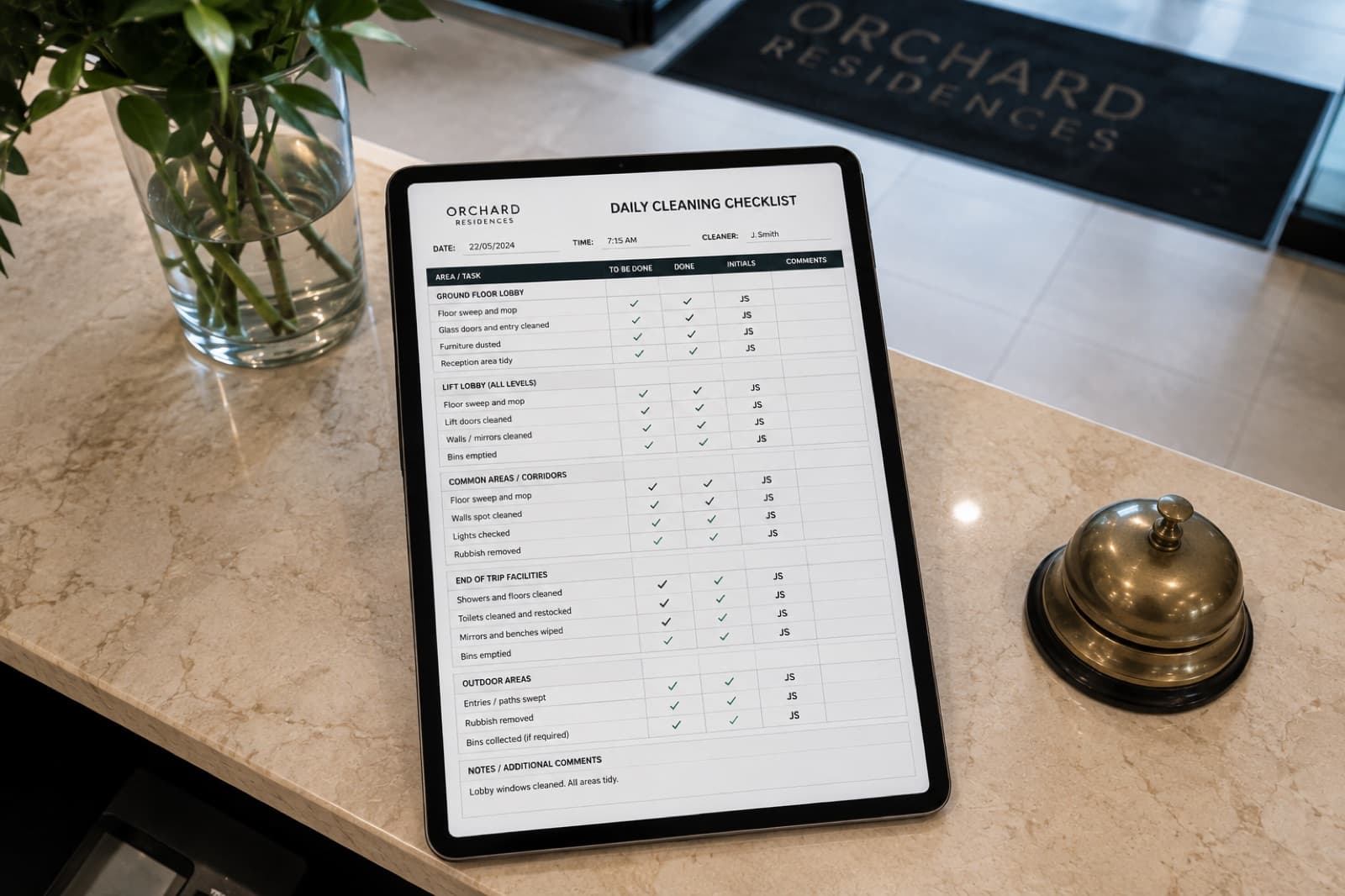
For each area, the tasks to be completed. Not just ‘clean the lobby’. Clean the lobby means: sweep and mop the floor, wipe the entry glass, clean the intercom panel, remove any rubbish, check and replace the door mat if required. The more specific the scope, the easier it is to hold the contractor accountable.
Reporting requirements
How you will know the work was done. A completion log, a digital check-in system, a signed sheet. Something. ‘Trust us’ is not a reporting system. Any contractor who resists reporting requirements is telling you something important about how they intend to operate.
Issue escalation procedures
What happens when something is found that is outside the cleaning scope: a maintenance issue, a damaged surface, a safety hazard. The cleaning contractor should have a process for flagging these to the building manager or committee. If they do not, issues will be discovered by residents instead.
Variations and additional works
How additional work outside the standard scope will be quoted and approved. This prevents scope creep and unexpected invoices.
The tender process
How many quotes to get
Three quotes is the standard for most strata decisions and it is the right number for cleaning contracts. Fewer than three and you do not have a real market read. More than three and the process becomes unwieldy without improving the outcome.
What to look for in a quote
A quote that arrives as a single line item (‘strata cleaning services, $X per month’) tells you the contractor has not engaged with your building’s actual requirements. A quote that breaks down by area and frequency tells you the contractor has at least read the scope.
Ask every contractor to include their reporting methodology in the quote. How will you know the work was done? If they cannot answer this question clearly, move on.
Reference checks
Ask for two reference contacts at buildings similar to yours. Not testimonials on a website. Actual people you can call. Ask those contacts three questions: Does the contractor show up on schedule? Do they communicate when there is a problem? Would you re-sign with them?
Red flags to walk away from
Contractors who quote without visiting the building. A quote produced without a site inspection is a guess, and it will be revised upward after the contract is signed.
Contractors who cannot name the person who will be responsible for your building. If the answer is ‘one of our team’, you do not have a named operator. You have a roster.
Contractors who resist a written scope. ‘We know what we’re doing’ is not a scope of works.
Contractors who have no reporting system. If they cannot tell you how you will know the work was done, the answer is: you will not know.
Managing the contract once it starts
The first three months
The first three months of a cleaning contract are the most important. Standards established in this period tend to persist. Standards that slip in this period are very difficult to recover.
Do a formal inspection in week two, week six and week twelve. Walk the building with your checklist. Compare what you find to what the scope says should have been done. If there is a gap, address it immediately and in writing.
Ongoing reporting
Review the completion logs monthly. If the contractor is not providing them, ask. If they are providing them and they show gaps, address it. The logs are your evidence if the relationship deteriorates and you need to invoke the contract.
Annual review
Review the scope annually. Buildings change. Tenancies change. Resident populations change. A scope written three years ago may not reflect the building’s current requirements. The annual review is also the right time to discuss whether the pricing reflects the current market.
When to change contractors
Change when the standard is not being held and the contractor is not responding to written requests to fix it. Change when the named operator changes and the new person does not know the building. Change when the reporting stops.
Do not change for price alone if the standard is being held. The cost of transition is real and is usually underestimated.
A worked example
To make the scope discussion concrete, here is what a frequency schedule might look like for a hypothetical 90-unit residential tower with a lobby, two lifts, ten residential levels, a basement car park, a bin room and a small gym. Your building will differ. The point is the level of specificity.
Lobby and entry: daily. Floor swept and mopped, entry glass wiped, intercom panel cleaned, mat checked. Lifts: daily. Floors, mirrors, buttons and tracks. Residential corridors: twice weekly, full length, all levels. Handrails and skirting weekly. Bin room: twice weekly cleaned and deodorised, full washdown monthly. Car park: swept fortnightly, pressure washed quarterly. Gym: daily. Equipment wiped, floors mopped, mirrors cleaned. Fire stairs: monthly. External entry paths: weekly, plus after storms.
Attach a task list like this to every area, put frequencies against every line and you have a scope a contractor can be held to. Ask each tenderer to price that document, not their own description of the building, and the three quotes you receive become genuinely comparable. This is the single change that does the most to keep a cleaning contract honest in year two, when the site inspection is a memory and the schedule is the only thing holding the standard up.
What ARTOO does differently
This guide has been written by ARTOO Cleaning, the operational cleaning arm of LUNA Management. We have written it because the problems described above are the problems we were founded to solve.
ARTOO operates with a named operator on every site, a written scope for every contract, a completion log for every visit and a flagging process for maintenance issues. These are not selling points. They are the minimum standard for a cleaning contract that actually works.
If you are a strata committee chair or building manager in Sydney and you are going to market for a cleaning contract, we would like to talk to you. Not to pitch. To understand your building and tell you whether we are the right fit.